

Table of contents
- Accuracy by audio condition
- Model-by-model error rates
- The language spread
- The human baseline
- Where AI transcription still fails unevenly
- Dictation speed: the measured numbers
- On-device transcription speed — our own measurement
- The numbers we left out
- Frequently asked questions
- Final thoughts on transcription statistics
- Sources
Quick answer: In 2026, the best speech recognition models transcribe clean, single-speaker English at roughly 2–3% word error rate — inside the 2–4% band NIST historically marked as the range of human transcription error. The same models average about 7.4% across varied real-world English audio and around 16% on distant-microphone meetings. Peer-reviewed research has measured an average 35% error rate for Black speakers versus 19% for white speakers across five commercial systems, and found hallucinated sentences in roughly 1% of Whisper transcriptions. Dictating on a phone was measured at 2.93 times faster than typing. Every figure on this page carries a primary source and the date we verified it — and the last section lists the widely quoted numbers we could not verify and therefore left out.
This reference was compiled by the LoroNote team and last verified on August 26, 2026. LoroNote runs Whisper Large V3 Turbo on the device, so we depend on these numbers being right; none of the benchmark figures below are our own, and the one measurement that is ours is labeled as such. If a statistic here is ever out of date, the linked source outranks this page.
Accuracy by audio condition
There is no single accuracy number for AI transcription — only numbers per condition. (Why a WER is meaningless without its test set is covered in our word error rate guide.)
| Audio condition | Word error rate | Model measured | Primary source | Verified |
|---|---|---|---|---|
| Clean read speech, one speaker (LibriSpeech) | ~2–3% | Whisper large models | OpenAI Whisper paper | 2026-08-19 |
| Eight varied real-world English test sets | ~7.4% average | Whisper Large V3 | Open ASR Leaderboard | 2026-08-23 |
| Meeting rooms, distant mics, cross-talk (AMI) | ~16% | Whisper Large V3 | Open ASR Leaderboard | 2026-08-23 |
| Same meeting corpus, speed-optimized variant | ~16.1% | Whisper Large V3 Turbo | Open ASR Leaderboard | 2026-08-23 |
Reading the table top to bottom: the software never changed, and the error rate grew by a factor of five. The audio is part of the number. We walked through this ladder in detail in How accurate is Whisper?
Model-by-model error rates
Figures below come from each model’s own documentation or from one third-party benchmark run; numbers from different evaluations use different text normalization and are context, not a ranking. (Normalization alone can move a LibriSpeech WER by more than a point.)
| Model | Reported figure | Primary source | Verified |
|---|---|---|---|
| Whisper Large V3 | 10–20% fewer errors than Large V2 across languages | openai/whisper-large-v3 card | 2026-08-19 |
| Whisper Large V3 Turbo | 809M parameters; “minor quality degradation” vs V3 | openai/whisper-large-v3-turbo | 2026-08-19 |
| Apple SpeechAnalyzer (iOS 26) | 2.12% test-clean / 4.56% test-other (LibriSpeech) | Lyonesse benchmark | 2026-08-23 |
| Whisper Small (same run) | 3.74% test-clean / 7.95% test-other | Lyonesse benchmark | 2026-08-23 |
| Whisper Tiny (same run) | 7.88% test-clean / 17.04% test-other | Lyonesse benchmark | 2026-08-23 |
| Apple SFSpeechRecognizer | 9.02% test-clean / 16.25% test-other | Lyonesse benchmark | 2026-08-23 |
| NVIDIA Parakeet TDT 0.6B V3 | 600M parameters; 7.83% avg WER on MLS; 11.97% on FLEURS; 25 European languages | nvidia/parakeet-tdt-0.6b-v3 card | 2026-08-26 |
Two cautions that the numbers themselves demand. First, the Lyonesse benchmark — the one that produced the viral “Apple beats Whisper” headline — tested only Whisper Tiny, Base, and Small, never the Large models that on-device apps actually run; we took that benchmark apart here. Second, Parakeet’s multilingual averages cover 25 European languages, while Whisper’s cover about 100 languages of very different difficulty — the two averages are not comparable, a trap we detailed in Parakeet V3 vs Whisper Large V3.
The language spread
OpenAI’s own published per-language chart for Whisper Large V3 puts the spread in one picture: on Common Voice 15, the best-scoring language (Dutch, 4.3%) and the worst (Albanian, 55.7%) are more than a factor of ten apart; on FLEURS the range runs from Spanish at 2.8% to Bengali at 50.0%. (Source: the language-breakdown chart in OpenAI’s Whisper repository, verified 2026-08-26 — we reproduce it in the WER guide, along with why several of those languages are scored by CER rather than WER.)
Coverage counts, for context: Whisper Large V3 covers about 100 languages; NVIDIA Parakeet V3 covers 25 European languages; Apple’s iOS 26 SpeechAnalyzer supported 22 languages across 42 locales as of August 2026.
The human baseline
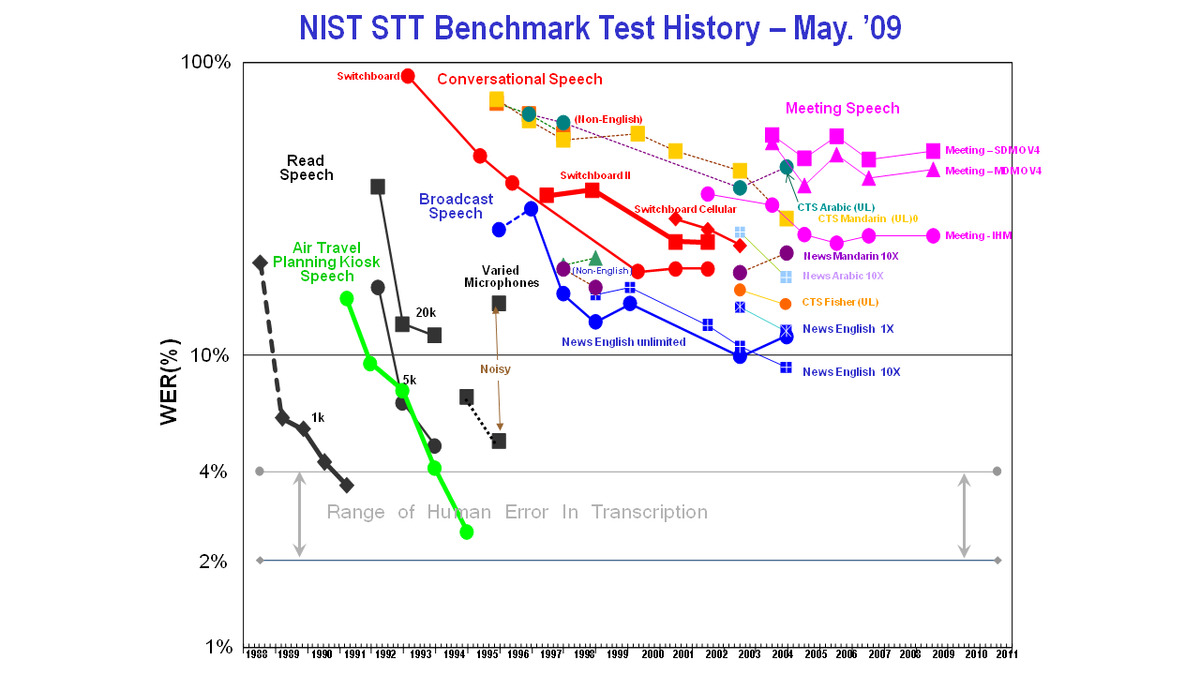
- 2–4% — the band NIST marked as the “range of human error in transcription” across two decades of its speech-to-text benchmark history (NIST Rich Transcription evaluation chart, public domain; verified 2026-08-26).
- OpenAI’s Whisper paper, whose models were trained on 680,000 hours of audio, claims the models “approach” human accuracy and robustness — approach, not surpass (Whisper paper abstract, verified 2026-08-26).
- Professional human transcription still sells above that baseline: Rev prices its human service at $1.99 per minute — about $119 per hour of audio — with a “99%+ accurate” guarantee, which reflects reviewed, multi-pass work rather than a single listener’s raw error rate (rev.com pricing page, verified 2026-08-26).
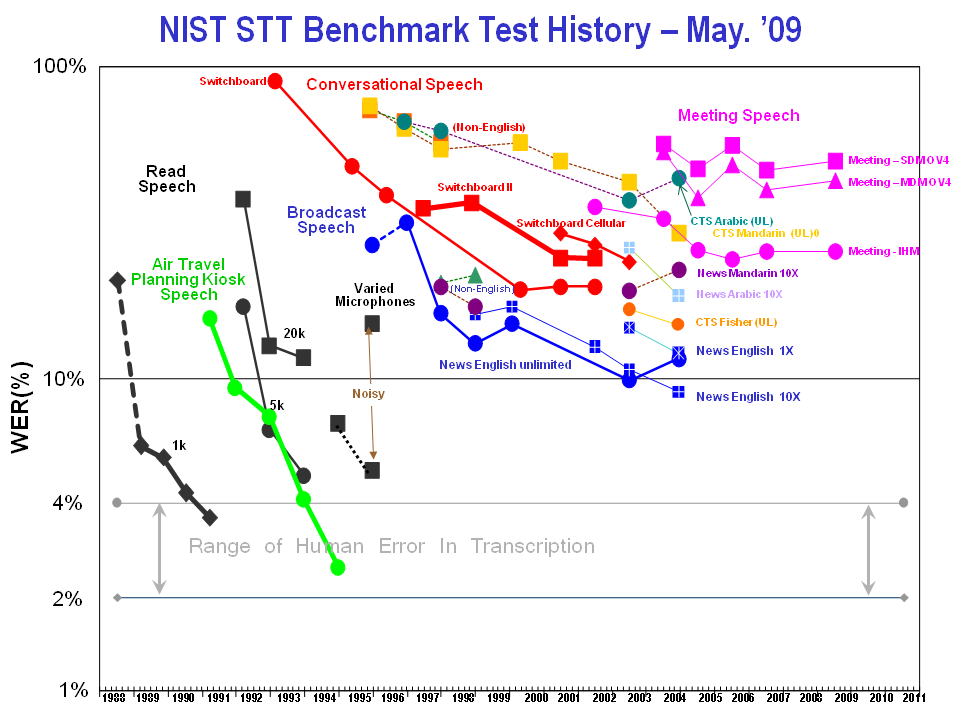
The NIST benchmark-history chart, with the 2–4% “Range of Human Error In Transcription” band running across the bottom. Source:
NIST Rich Transcription evaluation
(public domain).
The practical summary: on clean, close-miked audio, the best models now sit inside the historical human band. On hard audio, nothing does — human or machine.
Where AI transcription still fails unevenly
Two peer-reviewed findings that vendor pages rarely quote:
- 35% vs 19%. Across five commercial ASR systems (Amazon, Apple, Google, IBM, Microsoft), the average word error rate for Black speakers was 0.35 versus 0.19 for white speakers — measured on 2,141 matched audio snippets per group from the CORAAL and Voices of California corpora. The gap traced primarily to the acoustic models, not vocabulary (Koenecke et al., PNAS, March 2020; verified 2026-08-26). The systems tested date from 2019, so treat this as the best-documented measurement of the gap, not necessarily its current size.
- ~1% hallucinated, 38% of those harmful. A 2024 study of OpenAI’s Whisper API (as of 2023) found entire hallucinated phrases or sentences in roughly 1% of transcriptions; 38% of those hallucinations contained explicit harms such as invented violence or false authority. Hallucinations concentrated on the speech of people with aphasia — audio with longer pauses (Koenecke et al., arXiv:2402.08021, 2024; verified 2026-08-26). Why silence produces invented text — and why it can push a WER past 100% — is explained in the WER guide.
Both findings argue for the same habit: read your transcripts where the audio was hard, and treat silence-adjacent text with suspicion.
Dictation speed: the measured numbers
The most-cited controlled comparison of speech versus typing on a phone (Stanford/Baidu, tested on an iPhone 6 Plus with Deep Speech 2, published 2016–2018; verified 2026-08-26):
- English speech input was 2.93× faster than keyboard typing: 153 vs 52 words per minute.
- Mandarin speech input was 2.87× faster: 123 vs 43 WPM.
- Speech also produced fewer errors during entry (5.30% vs 11.22% corrected-error rate), though slightly more errors survived to the final text (1.30% vs 0.79%).
The study is a decade old and used a 2016-era recognizer; today’s models are more accurate than the one measured, but no comparably rigorous replication has replaced these figures, which is why they remain the standard citation.
On-device transcription speed — our own measurement
One number on this page is ours, so we label it: on an iPhone 15 Pro, LoroNote transcribes at roughly 19× real time with Whisper Large V3 Turbo running entirely on the device — a 10.5-minute recording in about 33 seconds, an hour of audio in about 3 minutes (LoroNote measurement, 2026-08-13). It is a first-party figure; the ten-minute test below is how you check it, and every other number here, against your own audio.
The numbers we left out
A statistics page is defined as much by what it refuses to print. The following figures circulate widely in transcription content; we tried to trace each to a primary source and could not, so they appear here only as warnings:
- “58% of professionals are uncomfortable with meeting bots.” Routinely attributed to a Calendly survey; the cited Calendly page contains no such survey. Competitor blogs cite each other. We documented the dead end when we researched bot-free meeting recording.
- “Gartner predicts 40% of meetings will restrict AI assistants.” Widely repeated; we found no Gartner publication stating it.
- Accent WER folklore — figures like “3% for Midwestern American English, 17% for Scottish English” appear across vendor blogs without a traceable study, dataset, or model. The PNAS finding above is the documented measurement of dialect disparity; the folklore numbers are not.
- Market-size projections. Research firms publish speech-to-text market estimates in the billions, but the methodology sits behind paywalls, so we cannot inspect what the numbers actually count. We exclude estimates whose basis we cannot read.
- “99% accurate” AI claims with no named test set. Not a statistic — an advertisement. The WER guide explains the difference.
Frequently asked questions
How accurate is AI transcription in 2026?
On clean, close-miked, single-speaker English, the best models reach 2–3% word error rate — inside the 2–4% band NIST historically marked as human transcription error. Across varied real-world English audio, the strongest open model averages about 7.4%; on distant-microphone meetings with cross-talk, about 16%. There is no single number: accuracy is a property of the model and the audio.
Is AI transcription as accurate as human transcription?
On easy audio, effectively yes: the best models sit inside NIST’s historical 2–4% human error band, and OpenAI’s own claim is that Whisper “approaches” human accuracy. On hard audio — distant microphones, overlapping speakers, heavy accents — neither humans nor machines reach those numbers, and reviewed professional services (sold at around $1.99 per minute) still exist precisely for the audio and stakes where a raw pass is not enough.
How much faster is dictation than typing?
The standard controlled measurement found phone dictation 2.93 times faster than keyboard typing for English — 153 versus 52 words per minute — with fewer errors during entry. The study dates to 2016; recognizers have improved since, but no equally rigorous replication has superseded it.
Why do transcription statistics differ so much between sources?
Three reasons, in rough order: different test audio (a 5% and a 16% figure can describe the same model), different text normalization before scoring (worth more than a percentage point on its own), and different metrics entirely — several languages are measured by character error rate, which is numerically lower than WER on the same output. Before comparing two published numbers, check all three; our WER guide shows how.
Final thoughts on transcription statistics
The honest shape of transcription statistics in 2026: machine accuracy inside the human band on clean audio, a fivefold penalty for hard audio, a documented demographic gap, a small but real hallucination rate, and a threefold speed advantage for speaking over typing. Every one of those claims links to a primary source above — and the numbers that could not meet that bar are listed by name, because a reference that prints everything is a reference for nothing.
Sources
- OpenAI, Robust Speech Recognition via Large-Scale Weak Supervision — training scale, clean-speech WER, human-comparison claim, normalization appendix
- OpenAI, whisper-large-v3 model card and whisper-large-v3-turbo model card — V3 vs V2 improvement, Turbo trade-off, per-language chart
- Open ASR Leaderboard — mixed-benchmark and AMI meeting averages
- Lyonesse, Apple’s New Speech API vs Whisper: The First Real Benchmark — SpeechAnalyzer, Whisper Tiny/Base/Small, SFSpeechRecognizer figures
- NVIDIA, parakeet-tdt-0.6b-v3 model card — parameters, languages, multilingual WER
- NIST, Rich Transcription evaluation — benchmark-history chart with the human error band
- Koenecke et al., Racial disparities in automated speech recognition (PNAS, 2020) — the 35% vs 19% disparity
- Koenecke et al., Careless Whisper: Speech-to-Text Hallucination Harms (2024) — hallucination prevalence and harms
- Ruan et al., Speech Is 3x Faster than Typing for English and Mandarin Text Entry on Mobile Devices — dictation speed measurements
- LibriSpeech ASR corpus — corpus scale and origin
- Rev, pricing page — human transcription price and guarantee
Each figure above lists its own verification date; the page-level pass was completed on August 26, 2026. When a linked source and this page disagree, the source wins.
Turn your voice into text — offline
LoroNote transcribes meetings, lectures, and interviews right on your iPhone — private, accurate, and unlimited.
Download on the App Store