

Table of contents
- The formula: three ways a transcript can be wrong
- WER versus “99% accurate”
- Not all errors cost the same — and WER doesn’t care
- Normalization: why one model gets two different scores
- A WER means nothing without its test set
- When “word” stops working: CER for Japanese, Chinese, and Korean
- How to measure your own WER in ten minutes
- Frequently asked questions
- Final thoughts on word error rate
- Sources
Quick answer: Word error rate (WER) is the standard yardstick for transcription accuracy. It counts the three ways a transcript can be wrong — a word substituted, a word deleted, a word inserted — and divides that total by the number of words actually spoken. A 10% WER means roughly one word in ten is wrong. The definition hides three surprises: WER can exceed 100%, the same transcript can earn two different scores depending on how the text was normalized before counting, and the number is meaningless without knowing what audio it was measured on. And for languages written without spaces, such as Japanese and Chinese, the industry switches to character error rate (CER) — a different metric that vendors often quote as if it were the same one.
This guide was written by the LoroNote team on August 26, 2026. LoroNote runs Whisper Large V3 Turbo on the device, so WER figures decide what we build and what we claim — and every figure below comes from OpenAI’s published paper and model cards or the public Open ASR Leaderboard, all linked at the end. None of them are our own measurements.
The formula: three ways a transcript can be wrong
WER compares two texts: the reference (what was actually said, transcribed by a careful human) and the hypothesis (what the machine produced). Every difference between them falls into one of three categories:
- Substitution (S) — a word replaced by another word
- Deletion (D) — a spoken word missing from the transcript
- Insertion (I) — a transcript word nobody said
The score is the total of all three divided by the number of words in the reference:
WER = (S + D + I) / N, where N is the number of words spoken — not the number of words in the transcript.
A worked example. Someone says: “send the report to Priya by Friday morning” — eight words. The transcript reads: “send a report to Prisha by Friday.” That is two substitutions (the → a, Priya → Prisha) and one deletion (morning): three errors over eight words, a WER of 37.5%. Notice what the example smuggles in: the mangled name is the error that would actually cost you something, and it counts exactly as much as the becoming a. More on that below.
Why WER can be higher than 100%
Substitutions and deletions are capped by the length of the reference — you cannot delete more words than were spoken. Insertions are not. A generative speech model given a stretch of near-silence can invent whole sentences, and every invented word is an insertion counted against a reference of almost zero words. That pushes WER past 100%, which is not a rounding bug but the formula working as designed. It is also why hallucination — Whisper’s documented tendency to produce fluent text when the audio goes quiet or turns to music — matters more than its share of average WER suggests; we compared how two model architectures differ on exactly this in Parakeet V3 vs Whisper Large V3.
WER versus “99% accurate”
Vendors rarely advertise a word error rate; they advertise accuracy. The conversion is simple — accuracy is roughly 100% minus WER — but the framing does a lot of quiet work. “99% accurate” sounds like a property of the product. A WER only ever describes a product on a particular test set, and the accuracy banner almost never names one. The same engine that earns 97% on clean, close-miked read speech can score 84% on a distant-microphone meeting without anything changing in the software. A precise accuracy claim with no test set attached is an advertising decision, not an evaluation.
The rule of thumb: whenever you meet an accuracy percentage, subtract it from 100 and ask “on what audio?” If the answer isn’t published, the number cannot be compared with anything — including the same vendor’s number from last year.
Not all errors cost the same — and WER doesn’t care
WER is deliberately democratic: a skipped “um” costs exactly as much as a wrong medication name — one error each. That neutrality is what makes the metric objective and comparable across systems, and it is also its best-known limitation. A transcript with five mangled filler words and a transcript with five mangled client names have identical WERs and very different consequences.
Evaluation teams sometimes work around this with keyword-weighted metrics or entity error rates, but the headline numbers you will encounter — in papers, on leaderboards, in marketing — are almost always plain WER. The practical consequence for anyone choosing a transcription tool: after any test, read the actual errors instead of stopping at the count. Where the errors land matters more than how many there are.
Normalization: why one model gets two different scores
Before anything is counted, both the reference and the hypothesis are normalized: lowercased, stripped of punctuation, with numbers, contractions, and spellings unified — is “twenty six” an error against “26”? Is “it’s” an error against “it is”? Is “colour” an error against “color”? Every evaluation answers these questions with its own rules, and the rules move the score.
OpenAI considered this important enough to ship a purpose-built text normalizer alongside Whisper and devote an appendix of the Whisper paper to how its choices change measured WER. On a benchmark like LibriSpeech, normalization differences alone can move a model’s published number by more than a percentage point — which is roughly the same size as the gap many head-to-head comparisons claim to have found.
This is why we keep repeating one caution across this blog, most recently in the Apple SpeechAnalyzer comparison: WER figures from two separately published evaluations are rough context, not a verdict. The only clean comparison is two systems scored in the same run, on the same audio, with the same normalizer.
A WER means nothing without its test set
The most-cited speech benchmark, LibriSpeech, is built from public-domain audiobooks and split into two halves whose names say everything: test-clean (clear recordings, easier speakers) and test-other (the harder remainder). One corpus, two conditions — and every model scores visibly worse on the second. That structure is the whole lesson of WER in miniature: the audio is part of the number.
Published figures for Whisper’s large models make the same point at full scale. On clean, single-speaker read speech, they reach roughly 2–3% WER. Averaged across eight varied real-world English test sets on the Open ASR Leaderboard, about 7.4%. On distant-microphone meeting recordings with overlapping speakers, around 16%. On a low-resource language like Hindi, published figures sit near 27%. Same weights, one order of magnitude of spread — we walked through that ladder rung by rung in How accurate is Whisper?
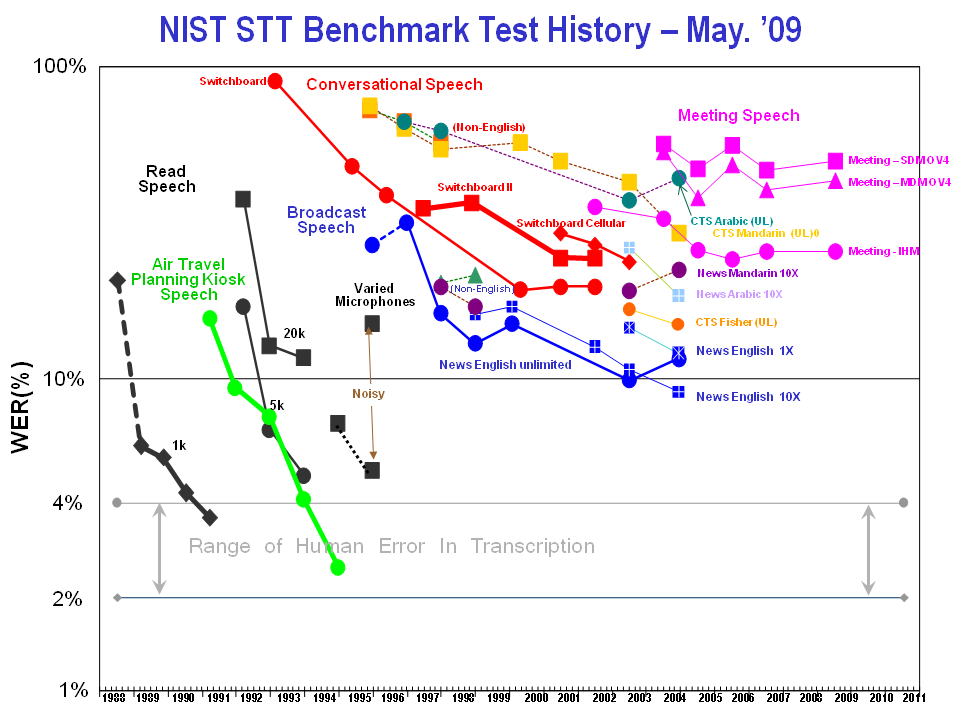
Two decades of NIST speech-to-text evaluations, one curve per benchmark task — read speech, broadcast news, telephone conversations, and meeting audio never converge to a single number. Source:
NIST Rich Transcription evaluation
(public domain).
The test set can also hide a different trap: which model was actually tested. The benchmark that went viral in 2026 claiming Apple’s new engine beat Whisper had measured Whisper Small — several sizes below the models on-device apps actually run. The headline number was real; the comparison was not.
When “word” stops working: CER for Japanese, Chinese, and Korean
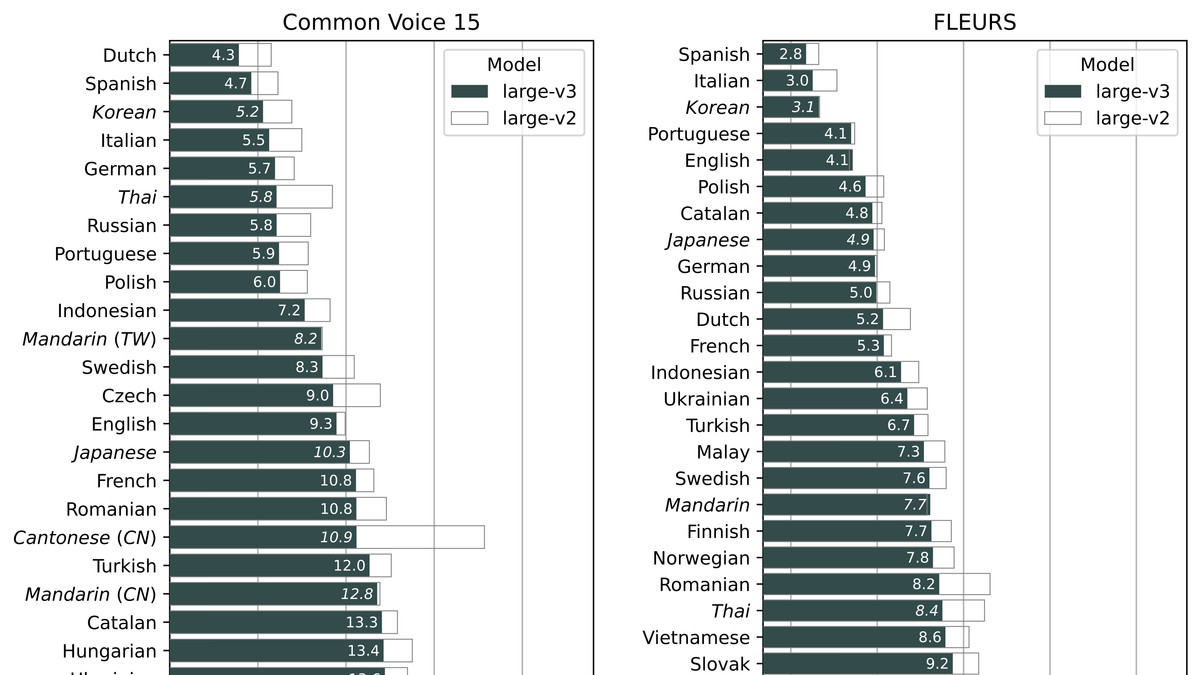
WER assumes you can split a sentence into words by looking at it. Japanese and Chinese are written without spaces, so “how many words is this sentence” is itself a modeling decision — two tokenizers give two different counts, and the error rate inherits the disagreement. For those languages, evaluations switch to character error rate (CER): the same substitution-deletion-insertion arithmetic, applied per character instead of per word. OpenAI’s own model card for Whisper Large V3 reports CER rather than WER for languages such as Japanese, Chinese, Korean, and Thai.
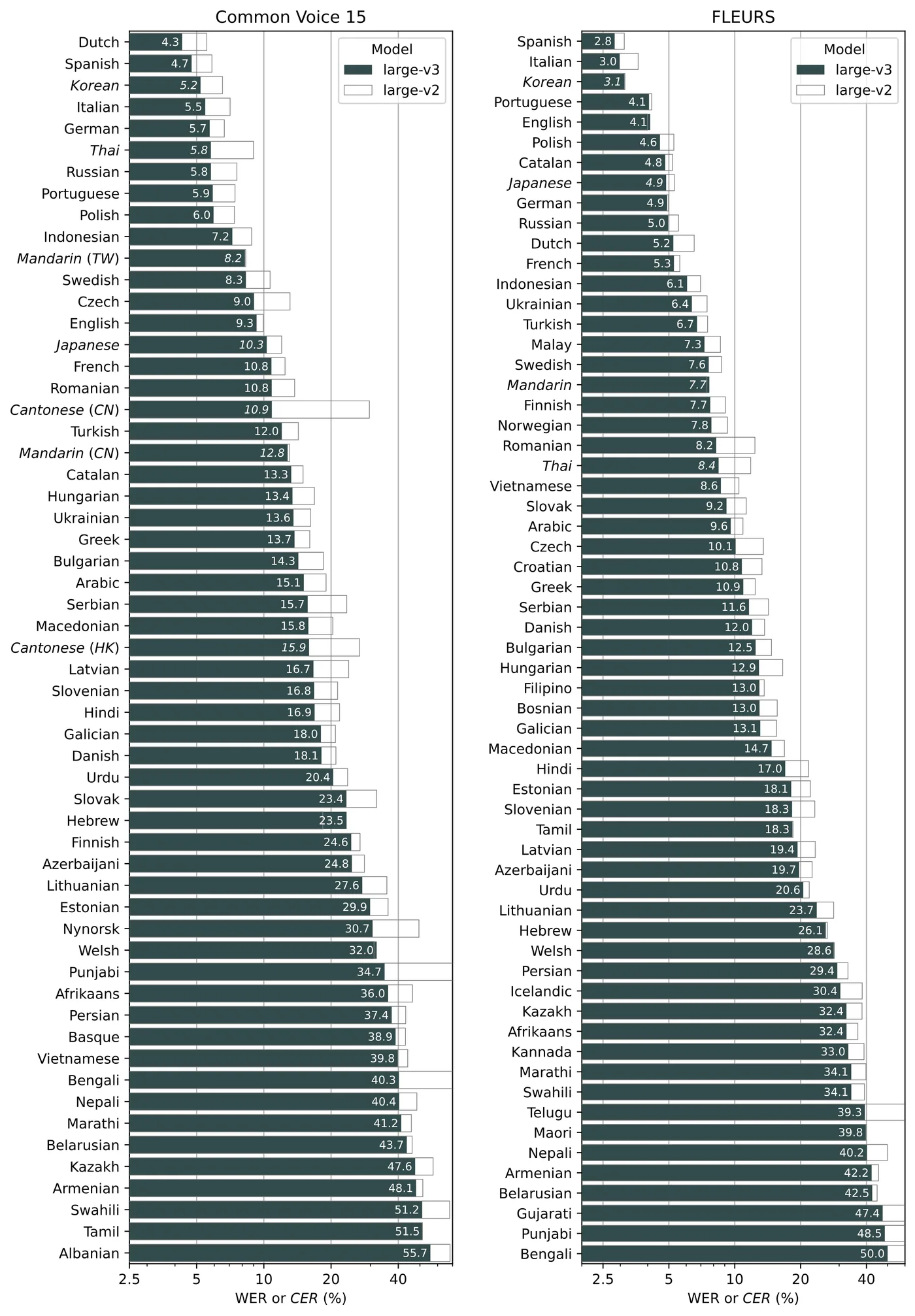
OpenAI’s published per-language error rates for Whisper large-v3 and large-v2 on Common Voice 15 and FLEURS. The languages set in italics — Korean, Japanese, Mandarin, Cantonese, Thai — are scored by CER; every other row is WER. Source:
OpenAI Whisper repository
(MIT license).
Korean is the instructive middle case: it has spaces, but particles attach to the words they follow, and legitimate spacing variation flips word boundaries without changing meaning — so a word-level count punishes differences no reader would call errors, and character-level scoring is the more stable choice there too.
The practical warning: a 5% CER and a 5% WER are not the same claim. Character-level scores run numerically lower than word-level scores on the same output, because one wrong word usually still contains several correct characters. A multilingual accuracy table that quietly mixes the two metrics — and many do — is not comparable across its own rows. This matters to us directly: LoroNote transcribes 100+ languages on the device, and “how accurate is it in my language” is only answerable once you know which metric your language is even measured with.
How to measure your own WER in ten minutes
Every number above was measured on someone else’s audio. The test that answers your question runs on yours, and it needs no tooling beyond a text editor:
- Record about two minutes of representative audio. Use the room and microphone distance you normally record at, in your language, with the names and jargon that actually come up — the test is only as honest as the sample.
- Transcribe it with the app you are evaluating.
- Decide your rules before you count. This is the step everyone skips, and it is the normalization problem from above in miniature: ignore punctuation and capitalization, pick one convention for numbers, and decide up front whether filler words count. Any rules work — as long as you fix them before looking at the output and keep them identical when you test a second app.
- Score a 200-word stretch. Compare the transcript against what was actually said and tally every substitution, deletion, and insertion. Divide by 200. That is your WER, measured on the one test set that resembles your audio perfectly.
- Then read the errors. A handful of garbled filler words and a handful of garbled client names produce the same score and call for very different reactions. If recurring names keep failing, that specific problem has a specific fix — teach them to LoroNote’s custom dictionary once and the model stops guessing.
LoroNote transcribes on the device, and the first two minutes of every recording are free — so the whole experiment costs nothing, works with Airplane Mode on, and the recording stays on your iPhone throughout.
Frequently asked questions
How do you calculate word error rate?
Add up the three error types — substitutions, deletions, and insertions — and divide by the number of words actually spoken: WER = (S + D + I) / N. N comes from the reference (what was said), not from the transcript, which is why heavy insertion can push WER past 100%.
What is a good word error rate?
It depends entirely on the audio. On clean, close-miked, single-speaker speech, modern large models reach 2–3% WER, near the practical ceiling; across varied real-world English audio, mid-single digits to about 10% is strong; on distant-microphone meetings with cross-talk, even flagship models run around 16%. A “good” WER is one measured on audio that resembles yours — a vendor quoting clean-speech numbers for a meeting-room use case is answering a different question.
Can word error rate be higher than 100%?
Yes. Insertions are not limited by the number of words spoken, so a model that invents text — for example, hallucinating sentences during a stretch of silence — can accumulate more errors than the reference has words. A WER above 100% almost always signals insertion problems rather than mishearing.
Why do two evaluations report different WERs for the same model?
Two reasons, usually stacked: different test audio and different text normalization. Normalization rules — how punctuation, casing, numbers, and contractions are unified before counting — can move a published LibriSpeech figure by more than a point on their own. Only two systems scored in the same evaluation run are cleanly comparable.
Is WER the right metric for every language?
No. For languages written without spaces, such as Japanese and Chinese, word boundaries are ambiguous, and evaluations use character error rate (CER) instead; Korean is usually better served by character-level scoring too. CER values run numerically lower than WER on the same output, so the two must never be compared directly.
Does WER measure whether speakers are identified correctly?
No. WER scores the words only. Attributing them to the right person is diarization, a separate step with its own error metric, and a transcript can have a low WER while attributing every line to the wrong speaker. How speaker identification works covers that half of the problem.
Final thoughts on word error rate
Word error rate is the most useful number in speech recognition and the easiest one to misuse. The formula is honest — three error types over the words spoken — but every published figure carries silent passengers: the test set it was measured on, the normalizer that prepared the text, and the metric switch that happens when the language stops using spaces. Read any WER with those three questions attached, and the numbers become genuinely informative. Better still, spend ten minutes measuring one on your own audio — no published benchmark will ever match it.
Sources
- OpenAI, Robust Speech Recognition via Large-Scale Weak Supervision — the Whisper paper; Appendix C covers the text normalizer and its effect on measured WER
- OpenAI, whisper-large-v3 model card — per-language figures, reported as WER or CER by language
- Open ASR Leaderboard — multi-benchmark English averages and AMI meeting figures
- LibriSpeech ASR corpus — the test-clean / test-other split
- LoroNote, How Accurate Is Whisper? Real Numbers — the published figures above, with their conditions
Figures re-checked against the linked sources on August 26, 2026.
Turn your voice into text — offline
LoroNote transcribes meetings, lectures, and interviews right on your iPhone — private, accurate, and unlimited.
Download on the App Store