

Parakeet V3 vs Whisper Large V3 (2026): Speed, Accuracy, and Which One Fits
Updated: LoroNote Team9 min
Table of contents
- Parakeet V3 and Whisper Large V3 at a glance
- Why Parakeet V3 deserves the attention
- Parakeet is not GPU-only anymore — so why still Whisper?
- For English, either model can be the right answer
- Why LoroNote uses Whisper Large V3 Turbo
- Which should you choose?
- Frequently asked questions
- The best model is the one that fits the recording
- Official sources
If you follow speech recognition models, you may have seen a simple claim: Parakeet V3 is faster and more accurate than Whisper. That can be true in the right benchmark, but it does not answer the question most people actually have: which model fits the way I record and transcribe?
For English-only batch transcription on an NVIDIA GPU, Parakeet TDT 0.6B V3 is an excellent option. It is compact, fast, and highly competitive on public ASR benchmarks. Whisper Large V3 covers a much wider set of languages and deployment environments. Its faster Turbo variant is a better fit for an app that needs to run privately on an iPhone or iPad.
That is why LoroNote uses Whisper Large V3 Turbo. The choice is less about picking a universal winner and more about balancing English accuracy, multilingual coverage, mobile speed, and offline privacy.
The short version:
- Choose Parakeet V3 for high-volume English or supported European-language transcription on NVIDIA hardware.
- Choose the Whisper Large V3 family when you need broader languages, mixed-language recordings, or flexible deployment.
- LoroNote uses Large V3 Turbo to bring that multilingual foundation to Apple devices at a practical speed.
Disclosure: This comparison was written by the LoroNote team. We checked NVIDIA and OpenAI model cards and official technical material on August 10, 2026. The NVIDIA chart is reproduced with attribution, and we also explain where Parakeet is the stronger choice.
Parakeet V3 and Whisper Large V3 at a glance
Parakeet V3 here means parakeet-tdt-0.6b-v3. The Whisper column includes the full large-v3 model and large-v3-turbo, the optimized version used by LoroNote.
| Category | Parakeet TDT 0.6B V3 | Whisper Large V3 | Whisper Large V3 Turbo |
|---|---|---|---|
| Parameters | 600 million | 1.55 billion | About 809 million |
| Main strength | High-throughput ASR | Broad multilingual ASR and translation | Faster multilingual ASR |
| Official language scope | 25 European languages | Broad multilingual coverage | Large V3-based multilingual ASR |
| English | Supported | Supported | Supported |
| Automatic language detection | Within supported languages | Yes | Yes |
| Translation to English | No | Yes | Not trained for translation |
| LoroNote | Not used | Foundation for Turbo | Runs on-device |
The parameter count is useful, but it does not predict the whole app experience. Runtime optimization, numerical precision, memory use, audio length, and hardware all affect speed. A model that flies through a batch on an NVIDIA GPU does not automatically have the same advantage on an iPhone.
Why Parakeet V3 deserves the attention
Parakeet V3 uses a Token-and-Duration Transducer, or TDT. In simple terms, it learns when it can skip audio frames that are unlikely to produce new text. That reduces wasted computation and helps the model process speech quickly.
Its official model card lists automatic punctuation and capitalization, word- and segment-level timestamps, automatic language detection, and long-audio support. For an English transcription service running many files on GPU infrastructure, that is a strong package.
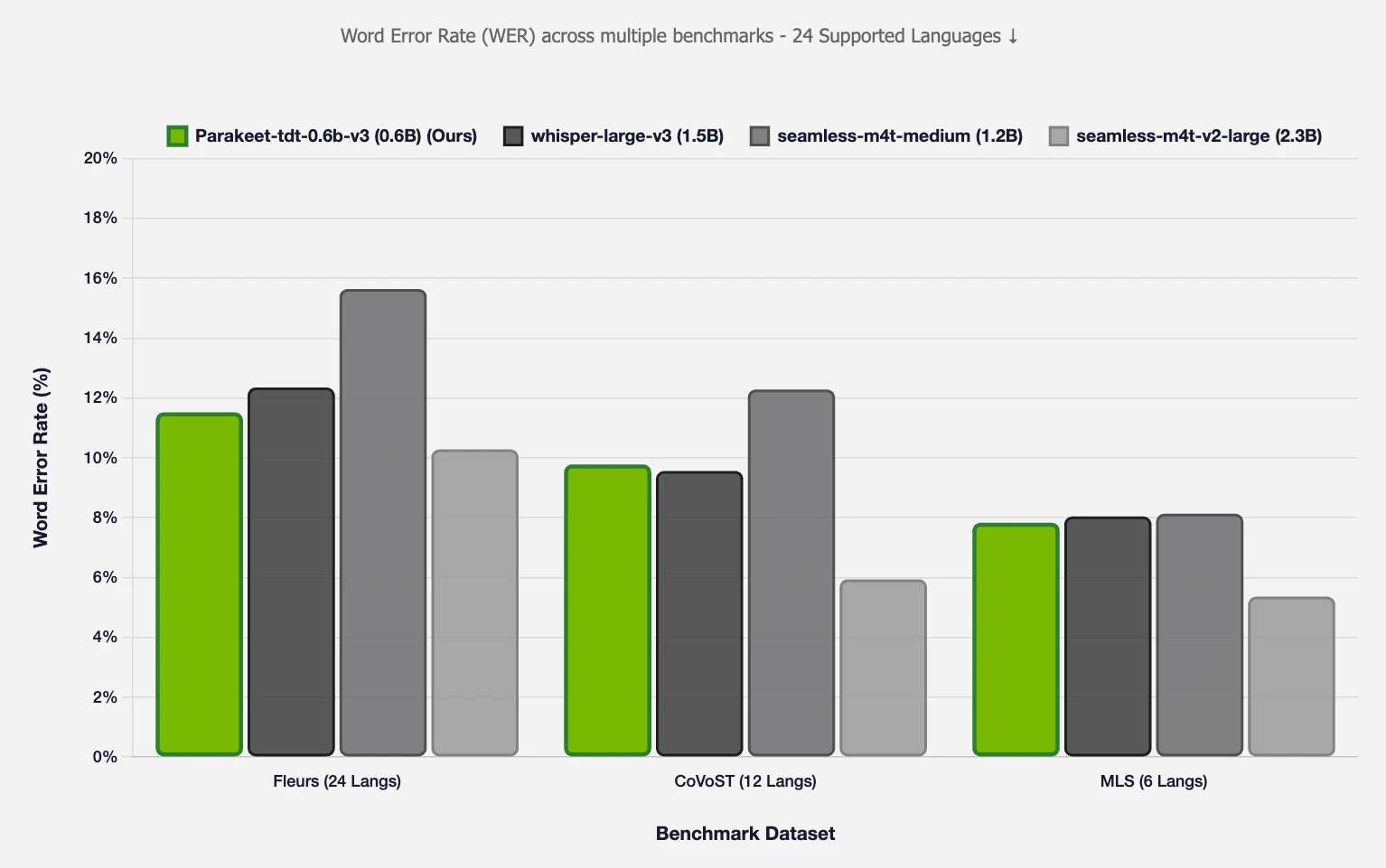
NVIDIA’s average WER comparison across 24 supported languages. Source:
NVIDIA Parakeet TDT 0.6B V3 model card
. CC BY 4.0.
In NVIDIA’s evaluation, Parakeet V3 posts a lower average word error rate than Whisper Large V3 on FLEURS and MLS. Whisper is slightly lower on CoVoST. That is impressive for a 600-million-parameter model competing with one more than twice its size.
The scope matters, though. The chart averages languages supported by Parakeet, excludes punctuation and capitalization errors, and comes from NVIDIA’s own model card. It is not an iPhone speed test, and it does not prove that Parakeet wins for every accent, microphone, or recording style.
The numbers behind the claim
Putting the published figures side by side makes the trade-off concrete:
- English accuracy: on the Hugging Face Open ASR Leaderboard, Parakeet TDT 0.6B V3 posts a word error rate around 6.3% against roughly 7.4% for Whisper Large V3. That is a real edge — and it is also about one word in a hundred, which your microphone and room affect far more.
- Multilingual average: on FLEURS across Parakeet’s supported languages, NVIDIA’s model card puts the averages close together — Parakeet around 12.0%, Whisper Large V3 around 12.6% — with each model ahead on different individual languages.
- Throughput: Parakeet’s transducer design is dramatically faster in batch settings; NVIDIA’s published real-time factors are more than an order of magnitude beyond Whisper’s. Speed is Parakeet’s clearest, least-disputed win.
One behavioral difference is worth knowing beyond the tables: Whisper is a generative decoder and is documented by OpenAI as sometimes producing text that was not spoken, most often on silence or noise. Parakeet’s transducer architecture emits text only when it detects speech tokens, so it hallucinates less on quiet passages. Good apps mitigate this around Whisper — but on raw model behavior, that point goes to Parakeet.
Parakeet is not GPU-only anymore — so why still Whisper?
An honest update to the usual framing: Parakeet no longer lives only on NVIDIA servers. Converted builds now run locally on Apple hardware, and some iOS and Mac apps ship Parakeet as a switchable engine precisely because it is fast. If Parakeet covered your languages, running it on a phone would be a legitimate choice.
The deciding factor is what it covers. Parakeet V3’s official scope is 25 European languages. Korean, Japanese, Chinese, Hindi, Arabic, Thai, Vietnamese — and most of the rest of the world’s languages — are not on the list. Whisper’s training spans roughly 100 languages, which is why a single Whisper model can handle a Korean meeting with English product names, or an interview that drifts between languages, without switching engines.
For a transcription app used across many countries, that difference is structural, not a benchmark detail. It is the main reason LoroNote builds on the Whisper family rather than the faster English-centric alternative.
For English, either model can be the right answer
Unlike Korean, Japanese, or Chinese, English is officially supported by both models. There is no automatic winner based on language availability.
Parakeet is particularly compelling when the workload is predictable: English audio comes into a server, an NVIDIA GPU processes a large batch, and the result needs accurate timestamps. If that describes your system, choosing Parakeet may be entirely sensible.
Whisper becomes more attractive when English is only part of the job. A US meeting may include Spanish customer quotes, Japanese names, or a French presentation the next day. Whisper lets one model cover a much wider range without changing the transcription pipeline.
Real recordings also differ from benchmark clips. Room echo, overlapping speakers, specialized vocabulary, and microphone distance often matter more than a small average WER difference. The most useful comparison is still the same recording on the hardware you plan to use.
Why LoroNote uses Whisper Large V3 Turbo
LoroNote is not a GPU transcription server. It is an iPhone and iPad app designed to turn meetings, lectures, interviews, and imported media into private notes. That changes the model requirements.
The full Whisper Large V3 model is powerful but heavy for long recordings on a mobile device. OpenAI created Large V3 Turbo by reducing the Large-series decoder from 32 layers to four. The model drops from 1.55 billion parameters to about 809 million, making transcription much faster while keeping the Large V3 multilingual foundation.
There is a tradeoff. OpenAI says Turbo performs similarly to Large V2 across languages, with larger drops in some languages, and it is not trained for speech translation. LoroNote’s primary job is transcription in the spoken language, so that tradeoff is a practical one.
The model is only the engine. LoroNote adds the workflow around it:
- on-device speaker detection
- timestamps that jump back to the matching audio
- a custom vocabulary for names and technical terms
- audio and video import
- editing plus TXT and SRT export
Processing location matters just as much. An app can use Whisper through a cloud API and still upload every recording. LoroNote runs Whisper Large V3 Turbo and speaker detection directly on your device. Recording and transcription work offline, so private conversations do not need to visit a transcription server. Read the offline transcription guide for the full workflow.
Which should you choose?
Parakeet V3 is a strong fit when you mainly transcribe English or another supported European language, control NVIDIA GPU infrastructure, and care most about batch throughput.
The Whisper Large V3 family is a stronger starting point when you work across languages, handle mixed-language audio, or need a model that already fits a broader device ecosystem. For private transcription on Apple hardware, Turbo offers the more useful balance.
Before deciding, record about two minutes in your normal environment. Include a few names, numbers, and product terms. Then check missing words, punctuation, timestamps, speaker changes, and processing time. A benchmark ranks models; your own recording tells you whether the result is useful.
Frequently asked questions
Is Parakeet V3 better than Whisper for English?
Not in every situation. Parakeet is extremely competitive on English and supported-language benchmarks and may be faster on NVIDIA hardware. Whisper offers broader language coverage and a more flexible ecosystem. Test both under the same audio and hardware conditions.
Is Whisper Large V3 Turbo the same as Large V3?
No. Turbo is based on Large V3 but reduces the decoder from 32 layers to four. It is smaller and faster, with some language-dependent accuracy tradeoffs, and it is not optimized for translation.
Does Parakeet V3 support Korean, Japanese, or Chinese?
No. Parakeet V3’s official language list covers 25 European languages. For Korean, Japanese, Chinese, and most non-European languages, the Whisper family is the practical choice — its coverage spans roughly 100 languages with one model.
Can Parakeet run on an iPhone?
Yes — converted builds run on Apple hardware, and some transcription apps offer Parakeet as a switchable on-device engine for its speed. Availability is not the deciding factor anymore; language coverage is. If your recordings stay within Parakeet’s 25 European languages, it is a fast option. If not, Whisper is the one that can transcribe them at all.
Does using Whisper mean audio goes to OpenAI?
Not necessarily. It depends on the app. LoroNote runs the model on your iPhone or iPad, so transcription does not require uploading audio to OpenAI or a LoroNote server. For how fast that actually is, see our measured speed figures in the Whisper apps comparison.
The best model is the one that fits the recording
Parakeet V3 is an excellent high-throughput model for English and its supported European languages. Whisper Large V3 is broader, while Turbo makes that foundation practical on a personal device.
LoroNote chose Turbo because a useful mobile transcription app needs more than a strong benchmark score. It needs to handle the languages people actually record, return results without a long wait, and keep private audio on the device.
Official sources
Turn your voice into text — offline
LoroNote transcribes meetings, lectures, and interviews right on your iPhone — private, accurate, and unlimited.
Download on the App Store