

Table of contents
- What “on-device” actually means
- The pipeline: what happens between microphone and text
- The hardware: what the Neural Engine does
- Does on-device transcription lose accuracy?
- How fast is it in practice?
- What on-device genuinely cannot do
- Frequently asked questions
- Final thoughts on on-device AI transcription
- Sources
Quick answer: On-device AI transcription means the speech-recognition model runs on your phone’s own processors — the recording is turned into text without ever being sent anywhere. The privacy claim is architectural rather than contractual: there is no upload step for your audio to take, which you can verify yourself by transcribing in Airplane Mode. On-device does not mean less accurate — the same model weights produce the same transcription wherever they run. What it does mean is a hardware budget: a phone’s memory, not its compute, decides which model size an app can load, which is why some apps quietly run Whisper’s small variants while others fit a Large-family model. Here is what actually happens between the microphone and the text.
This guide was written by the LoroNote team on August 27, 2026. LoroNote runs Whisper Large V3 Turbo entirely on-device, so this article describes the machinery our own product depends on. Every benchmark figure links to a primary source, most of them collected in our verified transcription statistics page; the one measurement that is ours is labeled.
What “on-device” actually means
Every transcription service performs the same task; the architectures differ in where the model lives.
| Step | Cloud transcription | On-device transcription |
|---|---|---|
| Recording | On your phone | On your phone |
| Upload | Audio travels to the provider’s servers | Does not exist |
| Speech model | Runs on server GPUs | Runs on the phone’s own processors |
| Result | Text comes back over the network | Text is written locally |
| Works offline | No | Yes — nothing requires a connection |
| Who can access the audio | You and the provider’s infrastructure | Whoever holds the phone |
The last two rows are the consequential ones. Offline operation is not a feature added to on-device transcription; it is a side effect of the architecture — nothing in the pipeline needs a network. And the privacy property works the same way: audio that is never uploaded cannot be retained, breached, or reviewed by a provider, not because a policy promises restraint but because no copy exists to restrain. That is a statement about architecture, not a legal guarantee — what it means for your own obligations is your call, but the technical fact is checkable in Airplane Mode.
The pipeline: what happens between microphone and text
Modern speech models like OpenAI’s Whisper process audio in a few concrete stages, all of which run locally in an on-device app:
- Resampling. The audio is converted to 16,000 Hz — the paper states all training audio is re-sampled to that rate, so anything higher is discarded before the model ever listens. (This is also why recording at studio sample rates does not improve accuracy.)
- The spectrogram. The waveform becomes a Mel spectrogram — per the Whisper paper, a log-magnitude representation computed on 25-millisecond windows with a 10-millisecond stride. The model never sees “sound”; it sees this image-like map of which frequencies carry energy over time.
- Encoding. A Transformer encoder digests the spectrogram into an internal representation of what was acoustically said.
- Decoding. A Transformer decoder writes the transcript token by token, using both the audio representation and the text it has produced so far — which is why Whisper reads fluently, and also why it can invent fluent text over silence.
None of these stages cares where it runs. A server GPU and a phone execute the same mathematics on the same weights — which is the whole reason on-device transcription became possible once phone silicon caught up.
The hardware: what the Neural Engine does
Phone chips stopped being just CPUs years ago. Apple’s A-series systems-on-a-chip carry a dedicated block for neural-network math — the Neural Engine — alongside the CPU and GPU, and Apple’s own iPhone 15 Pro announcement described the A17 Pro’s Neural Engine as up to twice as fast as its predecessor. Shipping transcription apps convert their models to Apple’s Core ML format so this hardware can execute the encoder and decoder efficiently.
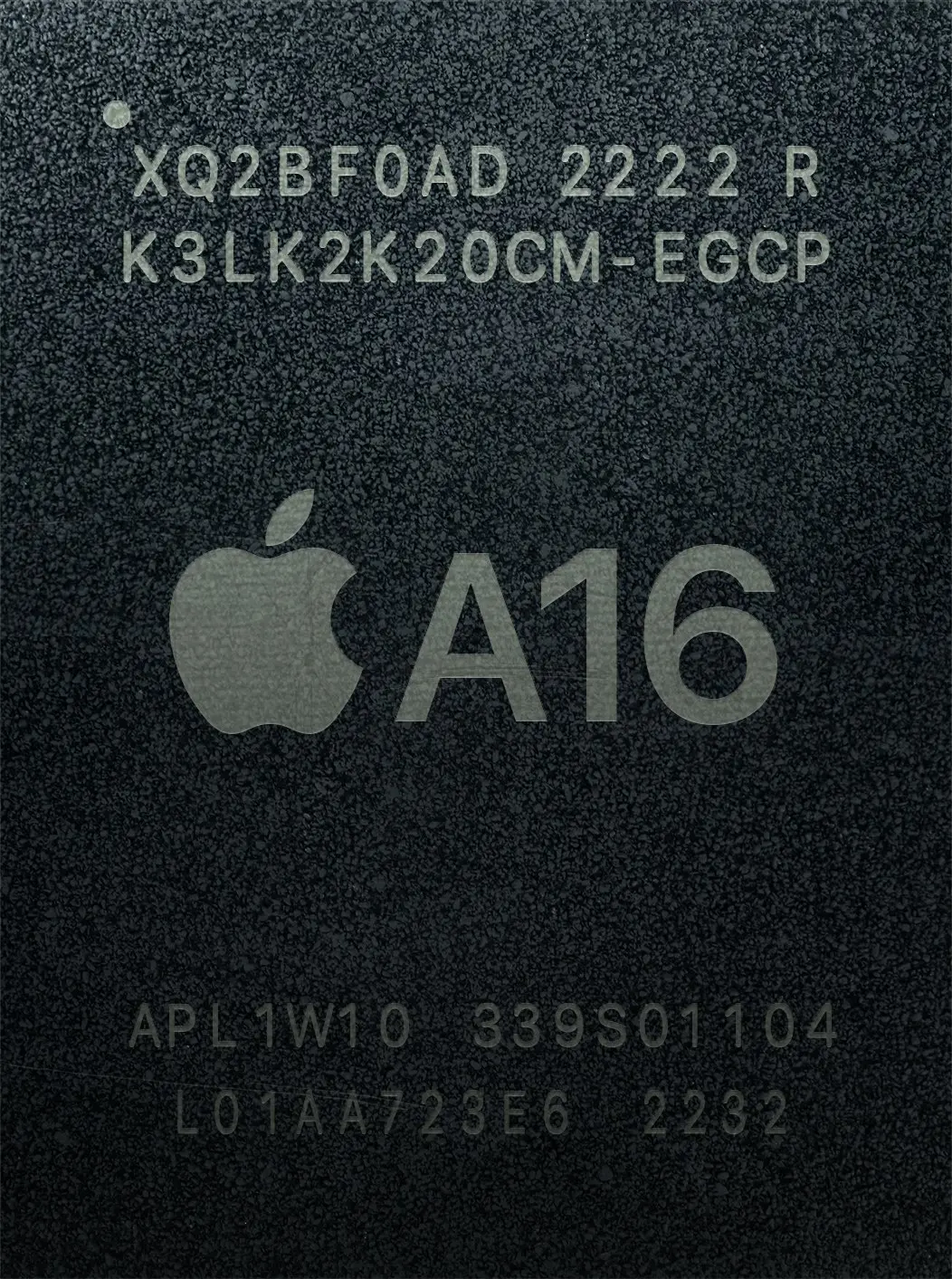
An illustration of an Apple A-series system-on-a-chip. Alongside the CPU and GPU, chips like this carry a dedicated Neural Engine — the block that executes speech-model math on the device. Source:

Wikimedia Commons (Henriok)
, CC0.
The practical constraint, though, is not how fast the silicon computes — it is how much model fits in memory. OpenAI’s published table makes the stakes concrete (parameters and reference footprints, measured on a server GPU):
| Whisper variant | Parameters | Reference memory | Relative speed (A100) |
|---|---|---|---|
| tiny | 39M | ~1 GB | ~10× |
| base | 74M | ~1 GB | ~7× |
| small | 244M | ~2 GB | ~4× |
| medium | 769M | ~5 GB | ~2× |
| large | 1,550M | ~10 GB | 1× |
| turbo | 809M | ~6 GB | ~8× |
Two honest caveats about that table. The memory and speed columns are OpenAI’s reference figures for GPU inference — a phone has no separate VRAM pool, and shipping apps quantize the models for Core ML, which changes both footprint and throughput. Treat the table as the relationship between variants, not as a phone spec sheet. But the relationship is exactly the point: a phone can hold a small model easily and a Large-family model only with real engineering effort, which is why several well-known iPhone apps quietly load small or medium even when their desktop versions run large. Whisper Large V3 Turbo — 809 million parameters with the decoder cut from 32 layers to 4 — exists precisely to make Large-family accuracy fit that budget; we explained why LoroNote chose it.
Does on-device transcription lose accuracy?
No — and this is the most persistent misconception about it. Model weights are deterministic mathematics: the same variant produces the same quality of transcript on a phone as on a server. On-device is not a degraded mode.
What differs between apps is which variant they load, and that difference is large — published figures put Whisper’s small variants at roughly double the error rate of Large-family engines on the same benchmark. So the accuracy question was never “cloud or device?” It is “which model?”, asked of every app individually. The measured numbers, from clean read speech to meeting rooms, are in How accurate is Whisper?
How fast is it in practice?
One number here is our own, so we label it: on an iPhone 15 Pro, LoroNote transcribes at roughly 19× real time — a one-hour recording becomes text in about three minutes, entirely on the device (LoroNote measurement, 2026-08-13). For context from another on-device engine, the benchmark of Apple’s iOS 26 SpeechAnalyzer reported throughput of roughly 12–40× real time on a desktop M2 Pro — with important caveats about what that benchmark did and did not test.
Speed on-device has one property cloud speed does not: it is yours. No queue, no rate limit, no per-minute meter — the marginal cost of transcribing another hour is battery, not billing.
What on-device genuinely cannot do
An honest definition includes the limits:
- The model improves only when the app updates. A cloud provider can swap in a better model server-side overnight; an on-device app ships its model inside the app, so improvements arrive with app updates, not silently.
- Big batch jobs still favor big hardware. Transcribing hundreds of hours for a research archive is faster on a desktop GPU or a paid cloud queue than on any phone.
- Anything inherently multi-user needs a server. A live shared transcript that ten people edit during a call is coordination, not transcription — when a cloud service is still the right call covers those cases.
- Sustained compute uses the battery. Transcription happens once per recording rather than continuously, but a long file is real work for the chip — plugging in for a three-hour batch is reasonable.
None of these change the core trade: for personal recordings — meetings, lectures, interviews, notes — the work happens on hardware you already own, at whatever accuracy the model you chose provides, with nothing leaving the device.
Frequently asked questions
Is on-device transcription really private?
Its privacy property is architectural: the pipeline contains no upload step, so no copy of your audio exists anywhere to be retained or breached. You can verify the architecture yourself — enable Airplane Mode and transcribe. What that fact means for your own confidentiality obligations is a judgment only you can make; the technical claim is simply that the audio stays on the phone.
Does on-device transcription work offline?
Yes, by construction — nothing in the pipeline needs a network. The model is downloaded once with the app; after that, recording and transcription work in a basement, on a plane, or in Airplane Mode.
Is on-device transcription less accurate than cloud transcription?
Not because of where it runs — identical model weights produce identical quality anywhere. Accuracy differences between apps come from which model variant each one loads, and phone memory pressure is why some apps choose small variants. Check the variant, not the venue.
Why do some iPhone apps run smaller Whisper models?
Memory. OpenAI’s reference table spans 39 million to 1.55 billion parameters, and the larger variants need several gigabytes even before phone constraints. Fitting a Large-family model on a phone takes deliberate engineering — quantization, Core ML conversion, a speed-optimized architecture like Turbo’s four-layer decoder — and not every app invests in it.
Is Apple’s built-in dictation also on-device AI transcription?
Increasingly, yes. Apple’s iOS 26 SpeechAnalyzer runs entirely on-device, like an on-device Whisper app — the differences are coverage and access: Apple’s engine supported 22 languages as of August 2026 versus about 100 for Whisper, and it requires iOS 26. We compared the two engines in detail.
Does on-device transcription drain the battery?
Transcription is a burst of real computation, not a background drain — it runs when you transcribe and stops when the text is done. Short recordings are negligible; for multi-hour batches, treat it like any heavy task and plug in.
Final thoughts on on-device AI transcription
On-device AI transcription is not a lesser copy of a cloud service; it is the same mathematics executed on silicon you already own. The definition worth remembering has three parts: the audio has no upload step to take (verifiable in Airplane Mode), the accuracy is a property of the model variant rather than the venue, and the phone’s memory — not its speed — is what decides which variant an app can carry. Judge any on-device app by that last question, because it is the one the marketing never answers.
Sources
- OpenAI, Whisper repository — model-size table (parameters, reference memory, relative speeds measured on an A100 GPU)
- OpenAI, Robust Speech Recognition via Large-Scale Weak Supervision — 16,000 Hz resampling, Mel-spectrogram front end, encoder-decoder architecture
- Apple, iPhone 15 Pro announcement — the A17 Pro Neural Engine “up to 2x faster” claim
- Lyonesse, Apple’s New Speech API vs Whisper — SpeechAnalyzer throughput range and its caveats
- LoroNote, AI transcription statistics — verified accuracy figures with primary sources and dates
Figures re-checked against the linked sources on August 27, 2026.
Turn your voice into text — offline
LoroNote transcribes meetings, lectures, and interviews right on your iPhone — private, accurate, and unlimited.
Download on the App Store