

When you choose a voice recording app, the features you can see are only half the story. The speech recognition model behind the interface determines which words are missed, how punctuation is handled, and how long you wait for a transcript.
LoroNote uses OpenAI’s Whisper Large V3 Turbo as its core transcription engine. “Turbo” is more than a marketing label. It describes a model derived from Large V3 and optimized to transcribe faster with less compute, making it far more practical to run directly on a personal device.
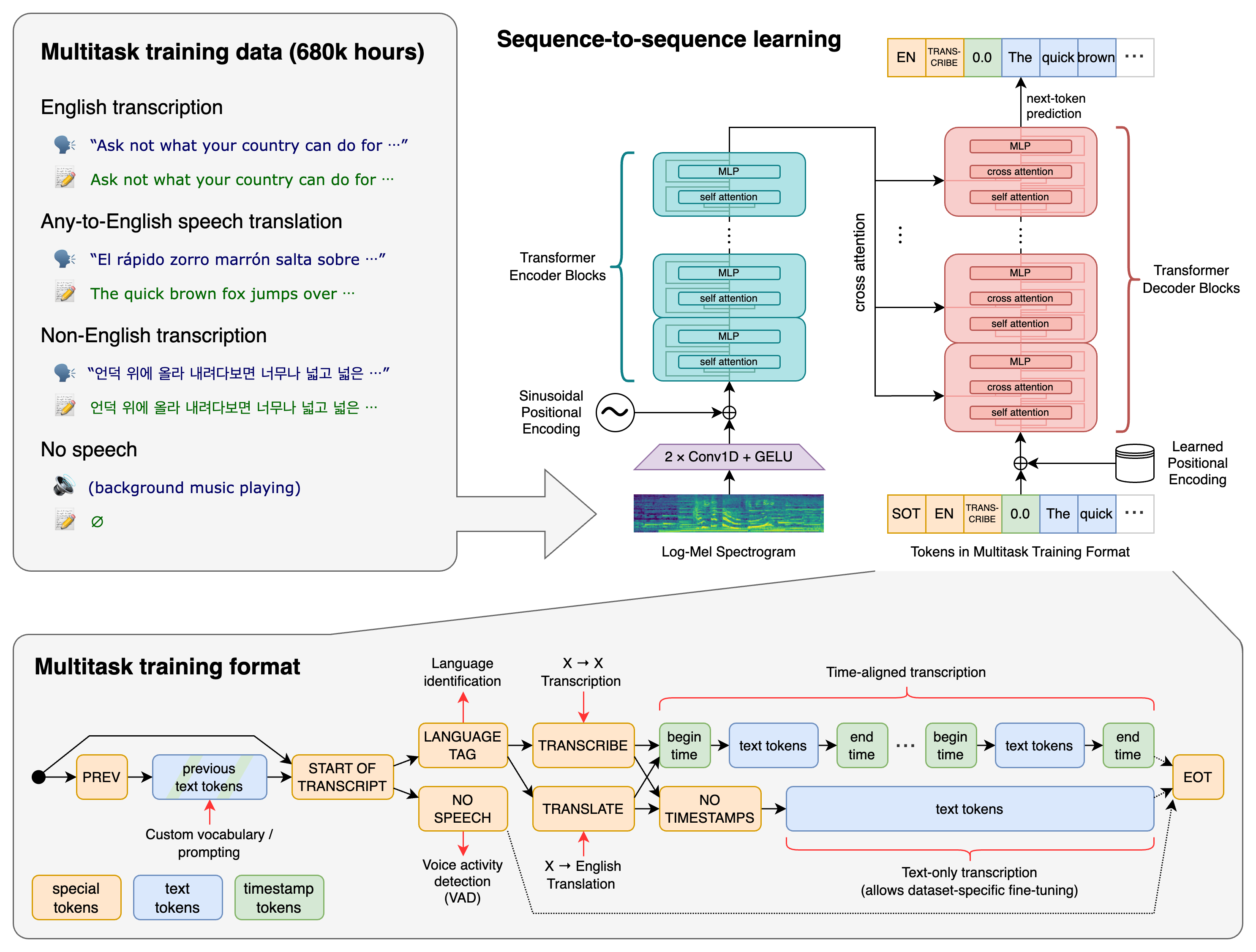
Hero image: the official Whisper architecture diagram from OpenAI. Large V3 Turbo is built on the same encoder-decoder design. The 680,000 hours shown in the diagram refer to the original 2022 Whisper release, not the amount of data used to train V3 Turbo.

The one-sentence answer
Whisper Large V3 Turbo keeps the Large V3 encoder but reduces the decoder from 32 layers to 4, substantially improving transcription speed while limiting the loss in accuracy.
That trade-off matters for LoroNote, where speech is processed on an iPhone or iPad rather than sent to a remote server. You do not need to install a model manually or learn command-line tools: record in the app or import an audio file and start the transcription.
What is Whisper Large V3 Turbo?
Whisper is OpenAI’s open automatic speech recognition system. It turns speech into text in the language being spoken and was designed to handle multiple languages, accents, background noise, and the imperfect audio people encounter outside a recording studio.
OpenAI released Large V3 Turbo in October 2024. It is not a completely new architecture. Instead, it is a more efficient version of Large V3, a model already known for strong multilingual transcription.
| Whisper Large V3 | Whisper Large V3 Turbo | |
|---|---|---|
| Model size | About 1.5B parameters | About 0.8B parameters |
| Decoder layers | 32 | 4 |
| Multilingual transcript | Supported | Supported |
| Multilingual average | Comparison baseline | Similar to Large V2; varies by language |
| Speech translation | Supported | Not optimized for translation |
| Compute requirements | Higher | Lower |
| Best suited to | Powerful computers | Fast and on-device transcription |
The audio encoder remains the foundation, while the text decoder—the part that repeatedly turns encoded audio into the next written token—is much shallower. OpenAI says this smaller decoder greatly increases transcription speed with minimal degradation in accuracy.
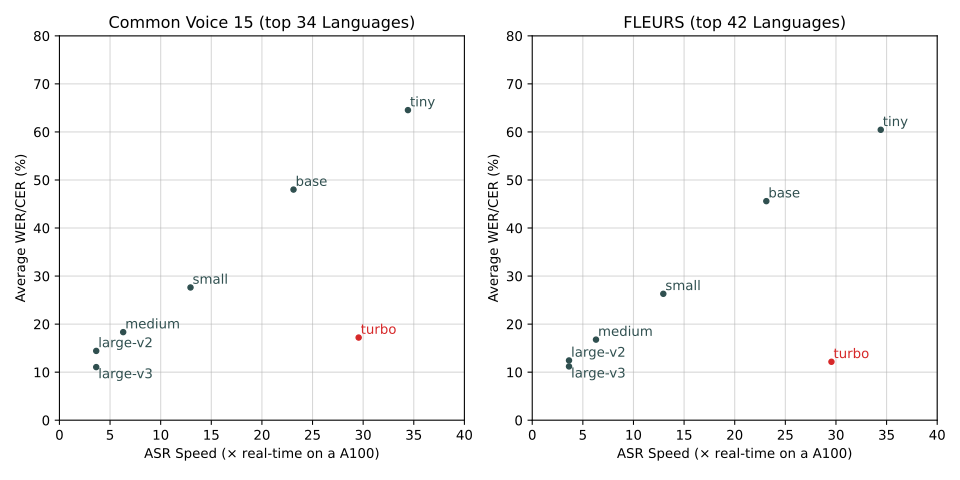
The chart makes both the benefit and the trade-off visible. Turbo processes audio much faster than full Large V3, but its average error rate is higher. OpenAI reports that, when results are combined across languages, Turbo performs similarly to Large V2 and loses more accuracy in some languages, including Thai and Cantonese. It fares better on FLEURS, whose recordings are cleaner than those in Common Voice.
Why the most practical model is not always the biggest
A larger speech model is not automatically the best model for every product. More parameters generally mean more memory, more computation, and potentially more heat and battery use. A slight accuracy gain is difficult to appreciate if a one-hour meeting takes unreasonably long to process.
Turbo aims for a more useful balance:
- Large-series context handling helps it follow the flow of meetings and lectures.
- A four-layer decoder reduces the repeated computation needed to produce text.
- One multilingual model can handle real conversations that contain different languages and borrowed terms.
- Lower processing requirements make private, on-device transcription practical.
Actual speed depends on your iPhone or iPad, the recording length, audio quality, and the way an app implements the model. A “five times faster” result from one device should not be treated as a universal promise. The durable advantage is structural: Turbo balances high-quality Large V3-based transcription against much lower compute.
What that means on a real iPhone
OpenAI’s speed figures are measured on data-center GPUs, so here is a number from actual Apple hardware: transcribing with Whisper Large V3 Turbo in LoroNote on an iPhone 15 Pro runs at roughly 19× real time, read from the app’s own progress display. In practice, a 10-minute recording takes about half a minute, and a one-hour meeting becomes text in around three minutes. Older devices are slower — the work scales with the chip — but the shape holds: a Large-series Whisper is now genuinely usable on a phone. The full measurement table, and how Turbo’s numbers compare with what other iOS apps run, is in our Whisper apps for iPhone comparison.
Why LoroNote uses Whisper Large V3 Turbo
LoroNote is not designed to win a contest for the largest possible model. It is designed to give you a useful record soon after a meeting, lecture, or interview ends—without sending the recording away from your device.
1. Multilingual transcription, including mixed terminology
Whisper Large V3 Turbo transcribes many languages with one model. A Korean meeting containing English product names, or an interview that moves between languages, does not require you to switch to a separate transcription provider for each one.
Punctuation is generated automatically as well. You do not need to dictate “comma” and “period” as you did with older voice input tools; the model uses audio and context to produce readable sentences.
2. On-device processing instead of a transcription server
In LoroNote, recording and transcription happen on your iPhone or iPad. Your audio is not uploaded to a transcription provider and placed in a server queue.
That difference offers more than offline convenience:
- You can transcribe on a plane, underground, or anywhere the connection is unreliable.
- Customer interviews, internal meetings, and private ideas are not sent to an external transcription server.
- There is no server usage meter forcing a limit on the number of minutes you record.
If you enable sync, your data can be synchronized through your own iCloud account. The AI computation that turns audio into text still happens on your device. Read our offline speech-to-text guide for a closer look at how this architecture works.
3. Efficiency that matters on long recordings
The difference between models may feel small on a ten-second voice memo. It is much more noticeable when the recording is a 60-minute meeting or a two-hour lecture. Reducing the amount of computation can shorten the wait and reduce pressure on memory and battery.
Large V3 Turbo combines Large-series transcription quality with the efficiency mobile hardware needs. That is why LoroNote uses it instead of simply choosing a much smaller Whisper model.
4. Turning model output into a usable note
Even an excellent speech model does not produce a finished meeting note by itself. You still need to find an important statement, identify the person speaking, and compare a questionable phrase with the original audio.
LoroNote builds on the Turbo transcript with:
- Sentence-level timestamps that jump to the corresponding moment in the recording
- On-device speaker diarization for multi-person audio
- In-app recording and audio file import
- Folder and calendar organization
- Transcript editing and sharing
Whisper Large V3 Turbo is the engine that turns speech into text. LoroNote turns that text into a note you can find, verify, organize, and use.
What determines real-world accuracy?
The same model will not produce identical results from every recording. These factors have a major effect:
- Distance from the microphone: Put the phone near the center of the conversation, not in a pocket or bag.
- Overlapping speech: When two people speak at once, their voices are physically mixed in one audio track.
- Background noise: Loud music and nearby conversations can mask the main speaker.
- Names and specialist terms: Company names, personal names, and uncommon abbreviations may need review.
- Language and accent: Whisper’s performance varies with language, accent, and speaking pace.
For the best results, keep the device close to the speakers. Before an important meeting begins, record a few seconds and check that every participant is clearly audible.
Turbo is not a perfect model
OpenAI’s Whisper model card documents several limitations: the model can generate words that were not spoken, accuracy varies across languages and accents, and output can become repetitive. Quiet passages and clips dominated by background noise deserve extra review.
Large V3 Turbo is also optimized for transcribing speech in its original language. Its fine-tuning data excluded Large V3’s speech-to-English translation task, so fast multilingual transcription and audio translation should be treated as different capabilities.
For high-stakes material—medical, legal, or decision-making records—always verify the transcript against the source audio. LoroNote’s timestamps let you jump straight to the relevant moment instead of replaying the entire recording.
Frequently asked questions
Does LoroNote really use Whisper Large V3 Turbo?
Yes. OpenAI Whisper Large V3 Turbo is LoroNote’s core speech-to-text model and runs directly on your iPhone or iPad.
Which is more accurate, Large V3 or Turbo?
Full Large V3 is generally more accurate. Turbo is designed to limit that loss while substantially improving speed and efficiency, but the gap varies by language and recording quality. For everyday mobile transcription, this balance is often more useful.
Does it work without internet?
Yes. Recording and transcription work offline, so you can turn speech into text without a network connection.
Can it transcribe languages other than English?
Yes. It supports a broad range of languages, including English, Korean, Japanese, Chinese, Spanish, French, and German. Accuracy still depends on the language, pronunciation, audio quality, and specialist vocabulary.
Do I need developer tools or a separate model installation?
No. LoroNote handles the model inside the app. You only need to record or import a file and start the transcription.
How fast is Whisper Large V3 Turbo on an iPhone?
On an iPhone 15 Pro, LoroNote’s in-app readout shows roughly 19× real time — about three minutes of processing for a one-hour recording. That is a first-party measurement on one device; older chips take longer. The point of Turbo is exactly this: a Large-series model fast enough that waiting is no longer the reason to avoid on-device transcription.
How does Turbo compare with NVIDIA’s Parakeet?
Parakeet V3 is faster and slightly ahead on English benchmarks, but it officially covers 25 European languages, while the Whisper family spans roughly 100. If your recordings include Korean, Japanese, Chinese, or most non-European languages, Whisper is the practical choice. We compared them in detail in Parakeet V3 vs Whisper Large V3.
A simpler way to use a powerful model
Whisper Large V3 Turbo’s value is not confined to its parameter count or decoder depth. It brings Large-series transcription to a speed and compute level that can be useful on your own device, without a round trip to a cloud transcription server.
LoroNote runs this model on iPhone and iPad, then organizes the result into a note with timestamps and speaker segments. Stop replaying every meeting, class, interview, or voice memo from the beginning just to write it down.
Download LoroNote on the App Store and turn your first recording into text with Whisper Large V3 Turbo.
Turn your voice into text — offline
LoroNote transcribes meetings, lectures, and interviews right on your iPhone — private, accurate, and unlimited.
Download on the App Store